Understanding asthma: a chronic inflammatory condition
Can asthma and cigarette smoking really coexist without serious consequences for the airways?
Asthma is a respiratory condition characterised by persistent inflammation of the bronchial tubes. This inflammation makes the airways particularly sensitive to various triggers such as allergens, air pollution, respiratory infections, and even changes in weather conditions.
According to the World Health Organization, around 262 million people worldwide live with asthma. The disease is responsible for approximately 455,000 deaths each year globally, making it a significant public health concern.
In Lithuania, asthma is also an important concern for respiratory health. It is estimated that more than 200,000 people may be affected by asthma in the country. Among children, asthma is one of the most common chronic respiratory conditions, particularly in urban areas where air pollution and environmental allergens can aggravate respiratory symptoms.
When an asthma attack occurs, the muscles surrounding the bronchial tubes tighten, the inner lining of the airways swells, and mucus production increases. As a result, the passage of air becomes more difficult, causing shortness of breath, wheezing, and a feeling of tightness in the chest.
Even with appropriate medical follow-up, asthma remains a condition that requires the healthiest possible respiratory environment. This is precisely where tobacco smoke becomes particularly problematic, as it can worsen airway inflammation and aggravate symptoms in people living with asthma.
Asthma and cigarette: what are the risks?
Cigarette smoke contains thousands of irritating chemical substances. Even in people who do not have asthma, these compounds can already impair lung function. In individuals with asthma, whose airways are already inflamed and highly sensitive, the impact is significantly greater.
Studies show that around one in four adults with asthma continues to smoke, despite their respiratory diagnosis. This proportion remains concerning given the well-documented harmful effects of tobacco on the airways.
Each inhalation of cigarette smoke increases bronchial irritation and intensifies the existing inflammation. The walls of the airways become thicker, more reactive, and more sensitive to triggering factors. Research indicates that smokers with asthma experience approximately twice as many severe exacerbations as non-smokers. Medical consultations are more frequent, and stabilising symptoms becomes more difficult.
Furthermore, the annual decline in lung function can accelerate by 50% to 100% in an asthmatic who smokes compared with a non-smoking asthmatic. In other words, breathing capacity deteriorates more rapidly, increasing the risk of persistent airway obstruction.
Over time, this ongoing inflammation may lead to a partially irreversible narrowing of the airways, making breathing more difficult even outside asthma attacks.
Can you smoke if you have asthma?
Tobacco smoke profoundly alters the environment of the airways. It disrupts the lungs’ natural defence mechanisms, particularly their ability to remove inhaled particles and repair irritated tissues.
In some smokers with asthma, inhaled anti-inflammatory medications become less effective. The airways remain more sensitive and more prone to contraction, and episodes of breathing discomfort tend to occur more frequently.
This interaction between asthma and cigarette smoking creates a vicious cycle: the more inflammation increases, the more reactive the airways become, and the more lung function gradually deteriorates.
Passive smoking: a real risk
Exposure to cigarette smoke, even indirectly, is far from harmless. Children who grow up in a smoke-filled environment have a higher risk of developing asthma. For those who are already diagnosed with the condition, asthma attacks tend to occur more frequently and can be more severe.
Developing lungs are particularly vulnerable to fine particles and irritating gases present in tobacco smoke. Hospital admissions related to asthma exacerbations are statistically more common in households where tobacco smoke is present.
As a result, the relationship between asthma and cigarette smoking does not concern only the active smoker, but also the people around them.
Asthma and vaping: airways still exposed
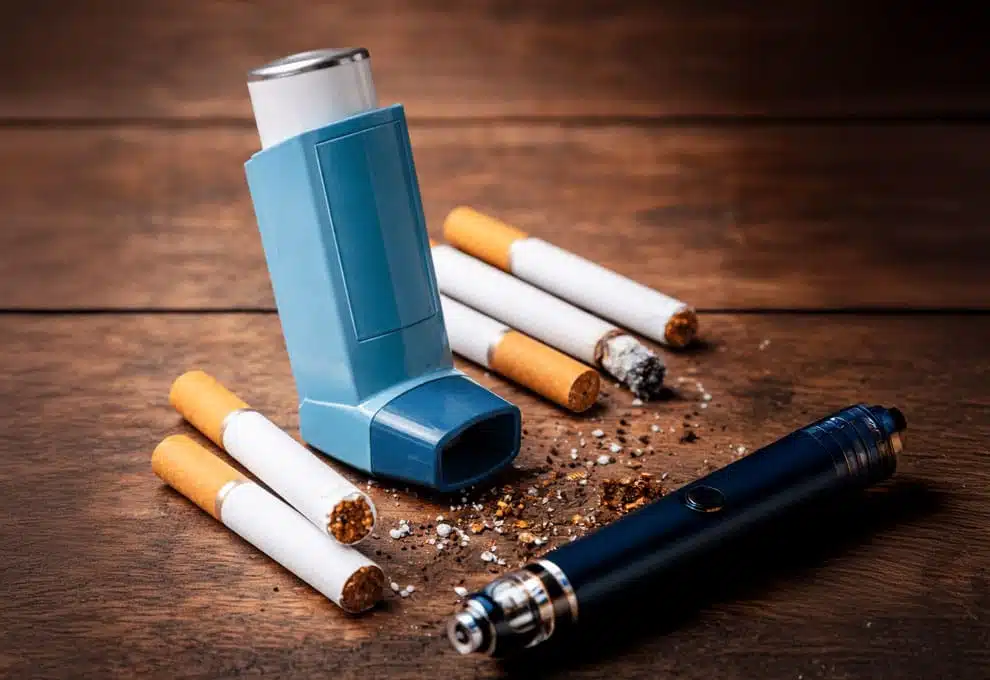
Electronic cigarettes are sometimes perceived as a less harmful alternative to traditional smoking. However, for people living with asthma, vaping is not without consequences.
The aerosols inhaled from e-cigarettes contain chemical substances, flavourings, and fine particles that can irritate the airways. Even without combustion, repeated inhalation of these compounds may trigger bronchial inflammation and increase airway hyperreactivity.
Several scientific studies have highlighted a worsening of respiratory symptoms among some regular users of electronic cigarettes, particularly in individuals who already suffer from lung conditions.
For people with asthma, exposure to any inhaled irritant can trigger wheezing, coughing, and breathing discomfort. Replacing traditional cigarettes with vaping therefore does not guarantee optimal protection for the airways.
Respiratory benefits after quitting smoking for people with asthma
When exposure to cigarette smoke stops, the airways gradually begin to recover. Inflammation decreases, lung function can improve, and asthma attacks often become less frequent.
Studies show that within just a few weeks, a measurable improvement in breathing capacity can be observed in people with asthma who stop smoking. The response to inhaled medications also tends to become more effective.
The earlier smoking cessation occurs, the greater the benefits. Even after several years of tobacco use, the lungs retain a certain ability to adapt and partially recover.
LaserOstop: acting on the physical component linked to nicotine
Given the close link between asthma and cigarette smoking, quitting tobacco becomes a priority for protecting the airways.
The laserOstop method is based on the stimulation of specific points located on the ear. This approach aims to act on the physical component linked to nicotine, allowing people to stop smoking immediately.
The session takes place in a centre within a professional setting. By eliminating daily exposure to cigarette smoke, a person with asthma removes a major aggravating factor and allows their airways better conditions to stabilise.
To support this step over time, laserOstop offers a one-year guarantee in the event of a relapse, allowing individuals to benefit from a new session if necessary. This guarantee provides reassurance and strengthens the commitment to a life without cigarettes.
Preserving one’s breathing capacity therefore becomes a clear and achievable objective.
Protecting your airways by quitting smoking
The link between asthma and cigarettes smoking represents a significant aggravating factor for respiratory disease. Tobacco smoke intensifies bronchial inflammation, increases the frequency of asthma attacks, and makes symptom control more difficult.
Vaping, often perceived as harmless, can also irritate already sensitive airways. For people living with asthma, limiting exposure to any inhaled irritants remains essential.
Quitting tobacco is therefore a decisive step in preserving lung function and improving quality of life over the long term.
Since its creation, the laserOstop method has already helped more than 500,000 people move towards a life without cigarettes. If you suffer from asthma and wish to protect your breathing in a lasting way, booking an appointment at a laserOstop centre may represent an important decision for your respiratory health.
Don’t wait any longer. Stop smoking now. Your breathing deserves to be protected.